Frozen Pipe Cleanup in West Yarmouth, MA
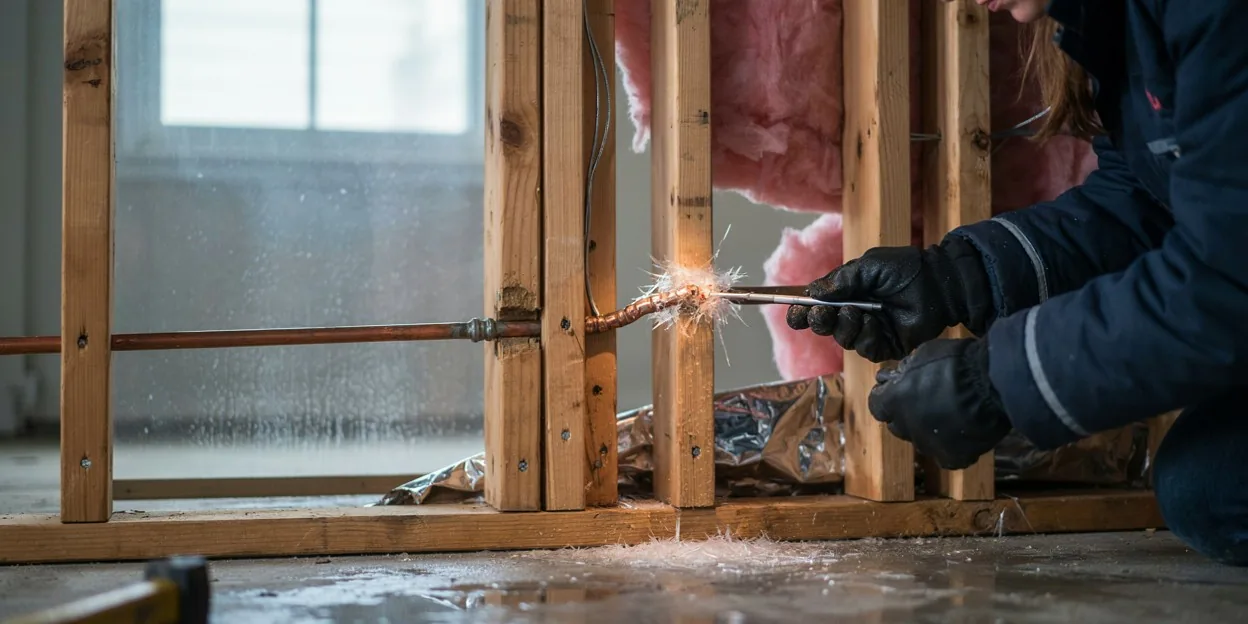
The forecast said single digits over Christmas weekend and the cottage in South Yarmouth was closed up for the winter. When you drove down in the second week of January there was a sheet of ice on the back step, water was still dribbling out of the wall behind the kitchen sink, and the pine floor in the hall gave under your boot. We put you on the phone with an independent local provider who cleans up after a frozen pipe in Yarmouth and across Barnstable County.
What the crew does first
The crew makes sure the water is off, then works out how long it ran. A split copper line does not leak while it is frozen. It leaks once it thaws, and if the thaw came two days after the cold snap and nobody arrived for three weeks, the house has had three weeks of water. That number shapes everything else.
Then they extract the standing water and meter every room, not just the one with the puddle. Frozen-pipe losses on the Cape almost always start in an outside wall, an uninsulated attic, or under a raised floor, and the water follows the framing down to the sill and into the crawl space. They look under the house early, because on a cottage that is where the water ends up.
What to do in the next hour
Shut the water off at the main valve or the well pump breaker. If a section is still frozen somewhere, leave the water off until a plumber has found the split, because a second section can let go as the house warms up. Turn the heat on if it is safe. Open the cabinet doors under sinks and the access panel behind the tub.
Do not use a torch or a heat gun on a pipe. Move rugs and boxes off the wet floor. Take photos of the wall, the floor, and the ice if there is any, then make the call. Repairing the pipe is a plumber's job. Drying the house is the cleanup crew's job, and they often work the same day.
What is usually saved and what is not
Framing and subfloor usually dry in place if the crew reaches them within a few days of the thaw. Drywall on the wet wall and the insulation behind it almost always come out, since the insulation held the water against the studs the whole time. Cabinet bases, laminate floors, and carpet pad usually go.
Pine and oak floors are the question mark. A floor that got wet for a day can often be dried with mats. A floor that sat wet for three weeks in a forty-degree house has usually cupped past saving. The crew meters the floor before anyone pulls it. Once the extraction is done, structural drying is the rest of the job, and on a raised floor it includes the space underneath.
Barnstable County notes: the empty-house loss
The Cape has a housing stock built for summer. The cottage colonies and ranches that went up along Route 28 and the south-side beaches in the 1950s and 1960s carry supply lines through outside walls and across unheated crawl spaces, and a large share are still second homes left empty from fall to spring. When the heat is set to fifty and the wind is off Nantucket Sound at thirty knots, a pipe in a north wall freezes anyway.
The Christmas cold snap of December 24 and 25, 2022 dropped temperatures into the single digits with wind chills below zero, and the arctic blast of February 3 and 4, 2023 went lower still. Both burst pipes in empty cottages, motels, and even public buildings across the Cape, and many owners did not find out until they came down weeks later. Some owners in Dennis Port, Eastham, and Truro shut off and drain the lines before leaving. If you do not, a smart water sensor or a neighbor with a key is the difference between a wet wall and a wet house.
Many policies cover a burst pipe as a sudden loss. Some apply a different rule when the house was unheated or unoccupied, and some require the water be shut off while the home sits empty. Nobody on this site can tell you what your policy says. Ask the crew to record when the water was found, the readings on the first visit, and the photos, so the timeline is on paper for your adjuster. If the loss soaked the basement rather than a crawl space, see basement flooding cleanup.
Calling about frozen pipe cleanup
Say when the house was last checked and when the water was found. Say which wall or room the water came from, whether it is shut off, whether the house is on town water or a well, and whether there is a crawl space or a basement. Mention if a plumber is already on the way. Call (508) 419-9161 now and tell us what you see.