Structural Drying in West Yarmouth, MA
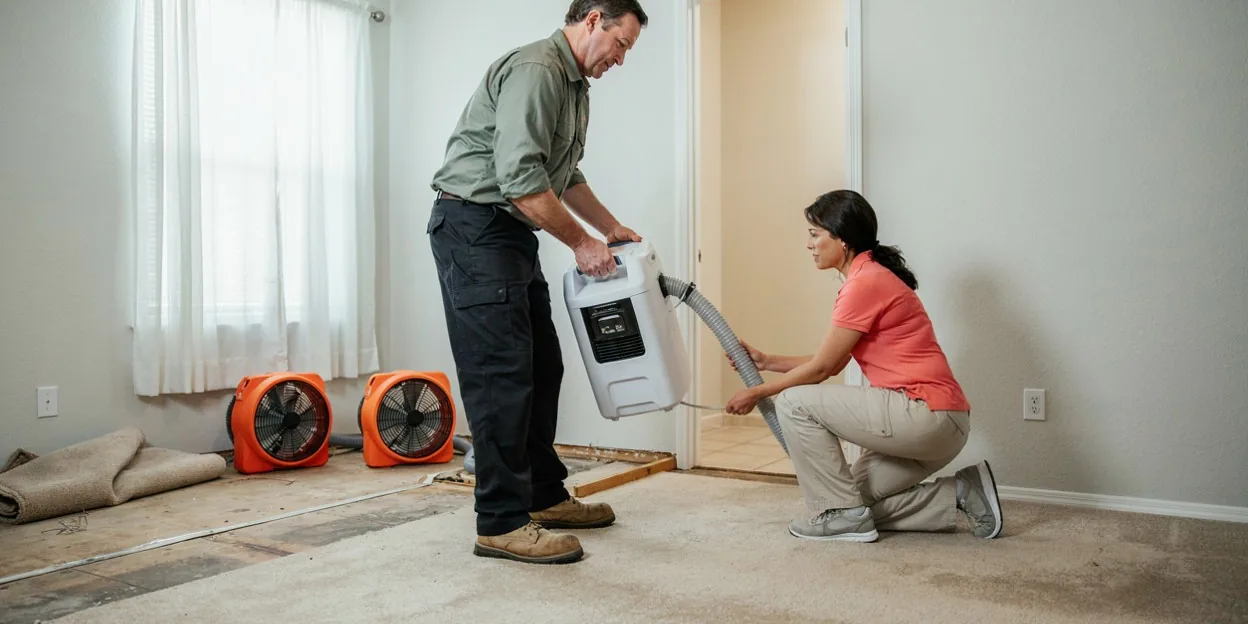
The plumber fixed the split line in the kitchen wall of your Yarmouth Port Cape three days ago and you mopped up what you could see. Now the baseboard is swelling, the pine floor has a ridge in it, and the whole first floor smells like a wet basement. We put you on the phone with an independent local provider who does structural drying in Yarmouth and across Barnstable County.
What the crew does first
The crew meters every room the water could have reached, not just the one with the puddle. They check the bottom of the drywall or plaster, the subfloor, the framing behind the wet wall, and the insulation, and on a house with a crawl space they check the joists from below. That gives them a map of what is wet and how wet.
Then they set air movers to push air across the wet surfaces and dehumidifiers to pull that moisture out of the air. Where the wall cavity is wet, they may drill small holes behind the baseboard and dry the cavity in place instead of opening the wall. In a cold, closed-up house they add heat, because drying slows to a crawl below fifty degrees. They come back to take readings until the numbers reach their target.
What to do in the next hour
Keep the heat on. Open closet doors, cabinet doors, and the crawl space hatch so air can reach the wet spots. Pull rugs off the floor and lift furniture onto blocks. Do not turn on ceiling fans or open windows to the sea air, and do not paint over a stain or replace trim yet.
Take photos of the swelling, the stain, and the cupped boards. Write down when the water started and when it was stopped. Then make the call.
What is usually saved and what is not
Framing, subfloor, and plaster on wood lath usually dry in place if the crew reaches them within a few days. Solid pine and oak floors are a case-by-case call and are often dried with floor mats that pull moisture up through the boards. Drywall that stayed wet for more than a few days usually comes out along the bottom, along with any wet insulation behind it.
Ask the crew what reading supports leaving something in and what reading supports taking it out. If the loss started with a frozen line in an empty house, read about frozen pipe cleanup, because the timeline changes the plan. If the water is still standing anywhere, water extraction comes first.
Barnstable County notes
Drying on the Cape fights the weather. Outdoor humidity runs high most of the year, and a house a quarter mile from Lewis Bay or Cape Cod Bay does not dry out on its own. In winter a cottage that was closed up sits at forty degrees, and cold, wet framing barely gives up moisture until the space is warmed.
The housing stock makes it harder. Ranches and Capes built between the 1950s and 1970s in Yarmouth, Dennis, and Harwich often have plaster over rock lath, pine floors nailed to a subfloor over a crawl space, and little insulation. Older houses on Route 6A have horsehair plaster, fieldstone or brick foundations, and framing that has already absorbed decades of damp. Each of those needs a different drying target, and the crew sets them by material, not by feel.
Many policies cover the drying that follows a sudden loss such as a burst pipe. Ask the crew for the drying log, the daily readings, and the photos so your adjuster sees the timeline. Once the readings are at target, the rebuild of drywall and trim is a separate job, and any new plumbing or wiring needs a permit from your town's building department.
Calling about structural drying
Say what the source was, when the water started, and when it was stopped. Say which rooms feel damp, whether the floor is cupping or the baseboards are swelling, and whether the house has a basement or a crawl space. Mention if the house was empty or unheated when it happened. Call (508) 419-9161 now and tell us what you see.